Flowable grout
Dense filling and easy placement.
Dry-mix mortar grade · AC-PCE 1030
AC-PCE 1030 is a redispersible powder polycarboxylate superplasticizer for high-flow cement- and gypsum-based mortar. It supports rapid plasticizing, strong water reduction and stable workability in factory dry blends.
Product profile
The polymer is designed to disperse binder particles quickly at low addition levels. It is intended for formulations requiring rapid wetting, high initial flow and limited loss of plasticizing performance during placement.
Evaluate it with cementitious or gypsum binders and the intended defoamer, retarder, expansive agent or hardening accelerator package.
Typical properties
| Appearance | Off-white to pale beige, free-flowing powder |
|---|---|
| Bulk density | 400–700 kg/m³ |
| Moisture | ≤3.5% |
| pH, 20% solution at 20°C | 7–9 |
| Chloride ion | ≤0.05% |
| Reference concrete air content | 1.5–6% |
| Reference concrete water reduction | ≥25% |
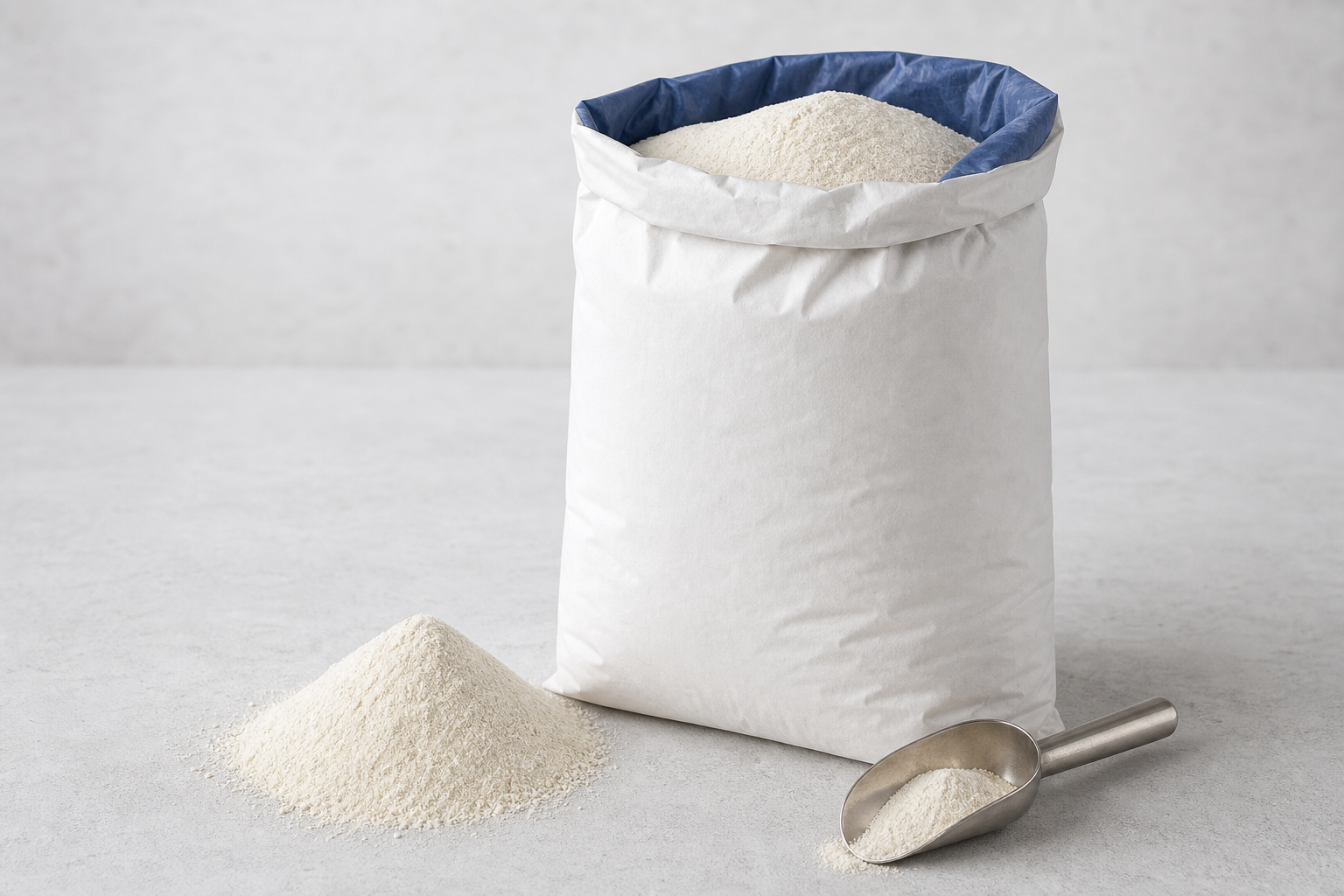
| Packaging | 25 kg bag with PE liner |
Typical reference values, not release specifications. Request the current AdmixChem TDS and batch certificate before purchasing or formulation approval.
Recommended applications
Dense filling and easy placement.
Controlled water demand and spreading.
Selected high-flow gypsum mortars.
Slurries, repair mortar and bagged products.
How it works
After wetting, the polymer adsorbs onto binder-particle surfaces. Charged groups and polyether side chains help separate particles that would otherwise flocculate. The released mixing water then contributes to flow instead of being trapped inside agglomerates.
Supports fast plasticizing and shorter development of initial flow.
Helps maintain particle dispersion and reduces unnecessary water demand.
Starting dosage
A practical screening range for powder PCE in dry-mix systems is 0.10–0.50% of total binder mass. This is a trial range, not a universal prescription.
Overdosing can increase segregation, entrained air or setting delay in some binder systems.
Grade selection
| Application | Primary target | Check during trial |
|---|---|---|
| Self-leveling mortar | Flow and leveling at controlled water demand | Segregation, bleeding, open time and surface finish |
| Non-shrink / flowable grout | Filling ability and dense placement | Air, expansion package, flow retention and strength |
| Gypsum or calcium-sulphate system | Rapid dispersion and smooth flow | Source-specific compatibility and setting time |
| Repair or specialty mortar | Workability without excess water | Thixotropy, adhesion, shrinkage and vertical stability |
Product-form comparison
| Decision point | AC-PCE 1030 powder | PCE liquid |
|---|---|---|
| Best fit | Factory dry blends and bagged mortar | Ready-mix concrete and liquid admixture systems |
| Water introduced with product | Minimal | Depends on liquid solids content |
| Dosing | Blended with dry components | Metered into the wet mix |
| Selection priority | Redispersion, dry-blend uniformity and binder response | Solids, slump retention and solution compatibility |
Need a liquid grade instead? Compare PCE superplasticizer liquid →
Evaluation workflow
Technical FAQ
It is a powder polycarboxylate superplasticizer used to improve flow and reduce water demand in selected cement- and gypsum-based dry-mix products, especially self-leveling mortar and flowable grout.
Use 0.10–0.50% of total binder mass as an initial laboratory screening range. The optimum dosage must be determined with the actual binder, fillers, sand and additive package.
Yes. Add it with the dry components and blend until uniform. After water is added on site, allow enough wet mixing time for full dispersion before evaluating flow.
It can be formulated with common dry-mix additives, but interactions affect air, rheology, setting and flow retention. Test the complete formulation rather than evaluating each additive separately.
Cement mineralogy, sulphate balance, fineness, supplementary binders and temperature influence PCE adsorption. A new binder source therefore requires a fresh dosage curve.
Depending on the system, excessive dosage may cause segregation, bleeding, increased air or delayed setting. Reduce dosage and rebalance the stabilizer, defoamer and set-control package based on test results.
Reseal it immediately and keep it cool and dry. Moisture ingress and compression can cause caking and make accurate dosing more difficult.
Yes. Send the application, binder type, target performance, trial quantity and destination through the contact page so the appropriate technical documents can be confirmed.
Send binder type, application, target flow, quantity and destination.