JG-02 · Concrete surface treatment
Concrete Surface Hardener & Densifier
A clear liquid treatment for formed concrete, applied by dilution and spraying to support surface densification. Evaluate JG-02 against your substrate, application method and required surface performance.
Discuss your surface-treatment project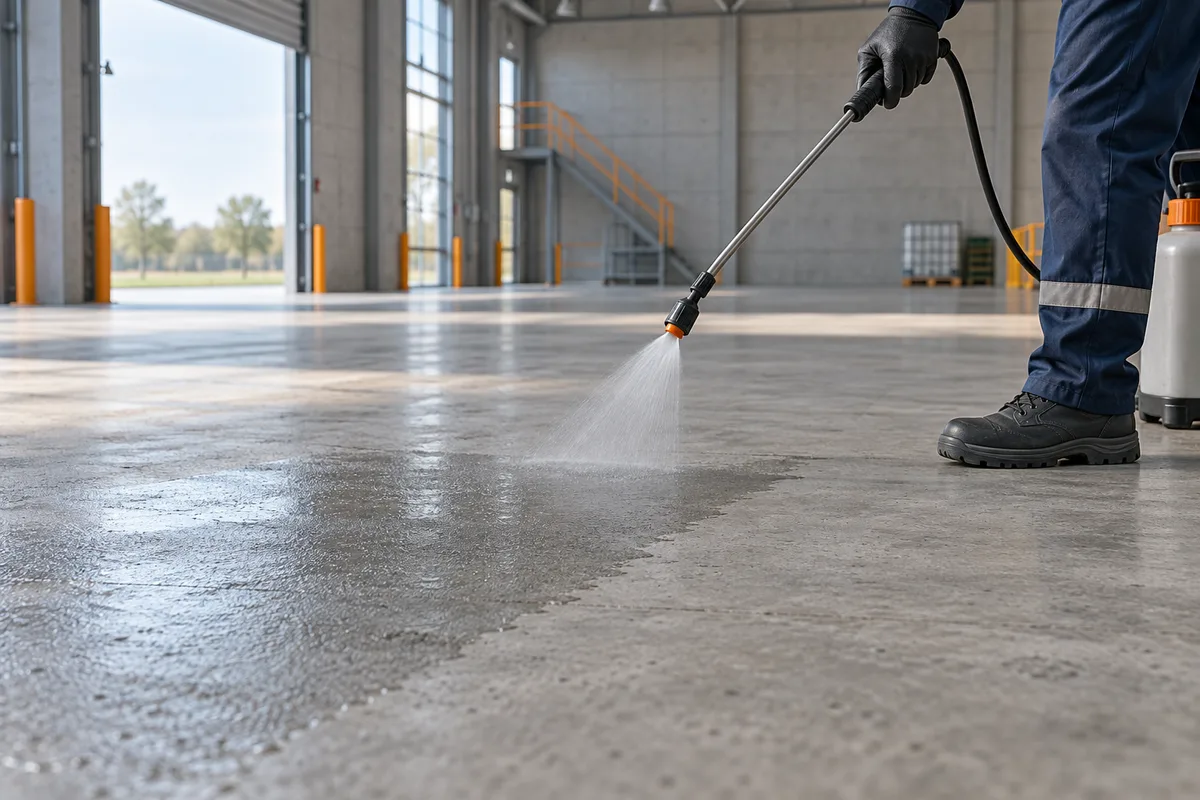
Choose by application stage
Surface treatment after concrete has formed
JG-02 is applied to the concrete surface. It belongs in a different selection route from additives dosed into the concrete mixer.
The supplied instructions describe penetration through surface pores and reaction with cementitious material and free calcium to form gels, primarily calcium silicate hydrate, within the surface zone.
Looking for a mix-design additive? See Concrete Strength Enhancer instead.
Start with a representative test area
Share whether the substrate is a slab, precast element or another formed concrete surface. Record age, surface finish, absorption, existing treatments and the problem you want to address.
For warehouse or workshop floors, assess dusting and abrasion in a controlled trial. These are evaluation objectives, not published JG-02 performance guarantees.
Supplied instruction-sheet reference
JG-02 product and application details
| Appearance | Clear liquid |
|---|---|
| Application route | Surface spraying after dilution with water |
| Dilution | 1 part product to 2–4 parts water, adjusted to substrate absorption. Confirm whether the supplier specifies a mass or volume basis. |
| Number of applications | At least 3 spray applications |
| Wet contact | Keep the surface wet for approximately 5 minutes per application, according to the supplied instructions. |
| Stated coverage | 3–5 m²/kg. Concentrate versus diluted-liquid basis and total-coat basis require confirmation before quantity calculations. |
| Packaging | 25 kg per pail |
| Shelf life | 12 months, under the supplier’s specified storage conditions |
| Storage | Cool, ventilated indoor location; keep away from fire sources and acidic materials. |
| Further specification needed | Chemical base, solids content, pH, density, application temperature range and return-to-service time |
Preparation → Dilution → Application → Review
How to plan a JG-02 application
Check and prepare the substrate
Assess the concrete and run a small-area trial. The instructions call for grinding away curing agents or release agents present on the surface, followed by spraying with clean water before treatment.Confirm the dilution
Use the stated 1:2–4 product-to-water range according to absorption. Confirm the mixing basis with the supplier. Do not blend with substances other than water.Spray to an absorbent, wet surface condition
The instructions recommend a sprayer and a visibly wet surface at saturated absorption. Plan at least three applications, maintaining wetness for approximately five minutes each.Record the trial and agree acceptance criteria
Measure actual consumption, appearance and the required surface properties against an untreated control. Confirm any residue-removal procedure, access restrictions and later coating requirements with the supplier.
Appearance and handling
The instruction sheet notes that a slight colour difference may occur after treatment. Check a sample area before treating appearance-sensitive concrete.
Protect eyes and skin during spraying and maintain local ventilation. Obtain the current SDS for specific protective equipment, handling and transport guidance.
Assess the surface, not just a rebound number
The sheet reports a noticeable rebound change after about 3 days and a higher reading at about 7 days. It also quotes a 15–30% “strength increase” without a supplied test method or report. This page does not treat that figure as a guaranteed compressive-strength improvement.
The ASTM rebound-number standard explains the limits of this test. Structural concerns need a separate engineering assessment.
Hardener, sealer or concrete admixture?
| Your objective | Selection route |
|---|---|
| Treat formed concrete at the surface | Evaluate JG-02 with representative substrate trials and agreed surface-performance criteria. |
| Change fresh-concrete mix performance | Review mix-design strength enhancers or PCE superplasticizers. |
| Provide stain, oil or waterproof protection | Specify a suitable protective system separately. Those properties are not established for JG-02 by the supplied sheet. |
| Repair cracks, deep deterioration or structural weakness | Obtain an appropriate repair assessment. Surface treatment alone is not a structural repair specification. |
For general category context, the Concrete Floor Construction Association distinguishes liquid densifiers from film-forming coatings. General category guidance does not establish JG-02 performance.
Questions before you specify JG-02
Is JG-02 mixed into fresh concrete?
No. JG-02 is diluted with water and sprayed onto formed concrete surfaces. The separately listed Concrete Strength Enhancer is a mix-design additive; its dosage does not apply to JG-02.
Is this a sodium, potassium or lithium silicate densifier?
The supplied JG-02 instruction sheet describes a reactive densification mechanism but does not identify the chemical base. Request the current composition and SDS before specifying a particular chemistry.
Can it be evaluated on an existing concrete floor?
An existing, absorbent concrete surface may be considered for a small-area trial after checking its condition and removing barriers to absorption. Confirm suitability for the actual substrate. Severe spalling, deep deterioration or structural defects require separate assessment.
Does a higher rebound reading prove higher compressive strength?
No. Rebound readings are affected by surface condition and are not a direct measurement of structural compressive strength. ASTM C805/C805M-25 says the method is not suitable as the basis for acceptance or rejection of concrete.
How many square metres will a 25 kg pail cover?
The supplied instruction sheet lists 3–5 m²/kg but does not identify whether this is based on concentrate or diluted liquid, or clearly define the complete-coat basis. Confirm these details and measure trial consumption before estimating pail quantities.
Is a densifier the same as a waterproof or stain-resistant sealer?
A surface densifier and a protective sealer have different functions. JG-02 has no supplied waterproofing, oil-resistance or stain-resistance test data. Confirm any additional protective system and its compatibility separately.
When can people or vehicles use the treated surface?
A verified return-to-service time is not given in the supplied instructions. Ask for project-specific guidance before scheduling access. The reported 3-day and 7-day rebound observations are not traffic-opening times.
Can I apply paint, epoxy or another coating afterwards?
Do not assume compatibility. Review the coating supplier’s preparation requirements and run an adhesion trial on the treated substrate before using a complete coating system.
Project inquiry
Send the substrate and target result
Include concrete age, surface condition, area in m², existing coatings, intended use and destination country. For a relevant quotation, ask us to confirm coverage basis, current documents, sample options and packaging.
Documents to confirm: current TDS and SDS, composition, available test reports and batch information. Availability and scope are confirmed for the selected grade.
Email JG-02 project details